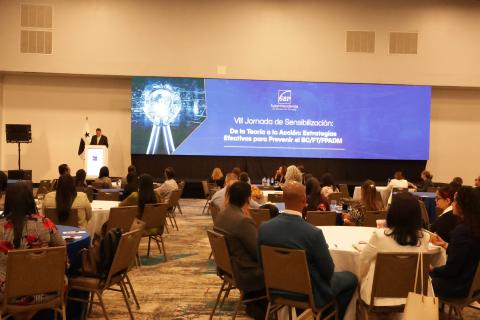

As part of its ongoing effort to promote awareness and training initiatives aimed at reinforcing the culture of compliance, the Superintendency of Banks of Panama (SBP) launched the 8th Awareness Workshop, “From Theory to Action: Effective Strategies for Preventing ML/TF/PFADM.”
The event brought together representatives from banks, trust companies, finance companies, leasing and factoring entities, money services businesses, exchange bureaus, means of payment and e-money issuers, card processors, and other key actors within the financial ecosystem, consolidating itself as a forum for knowledge exchange and technical strengthening for the sector.
The primary objective of these workshops is to provide participants with practical tools, greater operational clarity, and a comprehensive understanding of current challenges—fostering collaborative work between the regulator and the reporting entities to enhance risk prevention and management.
The event’s opening remarks were delivered by the SBP’s General Secretary, Kuldip Singh, who reaffirmed the institution’s commitment to the stability, integrity, and resilience of Panama’s financial system. He noted that this workshop seeks to promote a decisive shift “from theory to action,” encouraging the effective application of regulations and best practices through clear, practical, and results-oriented strategies.
The agenda addressed highly relevant topics in today’s environment, including the strengthening of compliance with targeted financial sanctions amid a complex geopolitical context; the importance of integrity in light of international scrutiny; risks associated with virtual assets and their conversion into fiat currency; challenges and opportunities in consumer protection; and the use of intelligent compliance solutions to optimize supervision and risk management.
The SBP expresses its appreciation to the invited speakers and to the World Bank, whose collaboration with Panama on international cooperation—particularly in the area of anti–money laundering—contributed significantly to the development of the topics covered in the agenda.