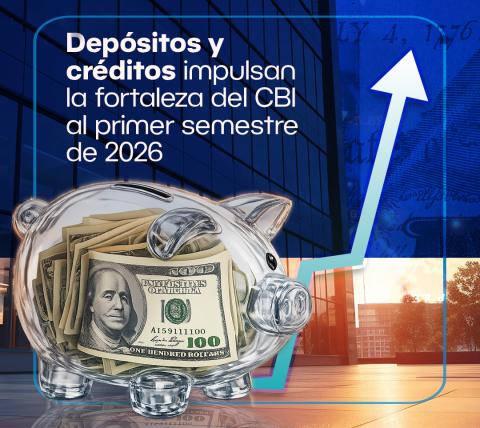

Depositor confidence and the continued expansion of lending activity continue to underpin the strength of Panama’s International Banking Center (IBC). At the close of the first half of 2026, Panama’s banking system recorded sustained growth across its main financial indicators, reaffirming its soundness, financial intermediation capacity, and strategic role as a regional financial hub.
These trends are reflected in the Banking Activity Report (IAB) published by the Superintendency of Banks of Panama (SBP), which highlights the positive performance of IBC deposits and the loan portfolio in the first half of 2026, reflecting depositor confidence and the continued momentum of financial intermediation.
IBC deposits reached USD 121,866 million, representing year-over-year growth of 7.69%, equivalent to an increase of more than USD 8,702 million compared with the same period in 2025. This performance confirms that deposits remain the banking system’s primary source of funding.
Growth was driven by both the local and international markets. Local deposits totaled USD 70,969.5 million, increasing by USD 3,374.9 million, or 4.99%, primarily due to a rise in deposits from individuals, which grew by USD 4,017.5 million, or 7.60%.
External deposits, meanwhile, reached USD 50,896.5 million, increasing by USD 5,327.4 million year over year, or 11.69%. Their share of total deposits rose from 40.3% to 41.8%, consistent with the IBC’s role as a regional financial hub.
The composition of this growth is a positive sign for the banking system. Deposits from individuals in both the local and external markets increased by a combined USD 8,135.5 million, or 9.13%, accounting for approximately 93.5% of the total increase in deposits and raising their share of total deposits from 78.8% to 79.8%.
Growth was also not concentrated solely in demand deposits. Individual savings and time deposits increased by a combined USD 5,447.9 million, or 7.26%, accounting for approximately two-thirds of the total increase in deposits within this segment. This points to greater stability in the system’s funding structure.
On the lending side, the net loan portfolio reached USD 103,512.3 million, representing year-over-year growth of USD 3,801.5 million, or 3.81%, reflecting the continued expansion of financial intermediation.
The local loan portfolio, net of provisions, stood at USD 63,783.1 million, an increase of USD 891 million, or 1.42%, while the external loan portfolio reached USD 39,729.1 million, growing by USD 2,910.5 million, or 7.91%. Accordingly, approximately 77% of the growth in the loan portfolio came from external lending, consistent with the IBC’s regional reach and its capacity to conduct operations beyond the local market.
The IBC’s total net assets reached USD 169,630.0 million, increasing by USD 11,025.8 million year over year, or 6.95%. This growth was driven primarily by loans and investments in securities, which together increased by 7.32%, raising their share of total assets from 84.0% to 84.3%.
Net liquid assets totaled USD 18,605.8 million, growing by 7.20% and maintaining a stable share of the balance sheet.
Prudential indicators continue to reflect the financial strength of the system. IBC’s Legal Liquidity Ratio stood at 58.83%, well above the regulatory minimum of 30%. Meanwhile, the Capital Adequacy Ratio (CAR) reached 16.04% at the end of March 2026, comfortably exceeding the regulatory minimum of 8% and the additional requirement associated with the capital conservation buffer.
These results demonstrate that the IBC maintains a sound financial position, with the capacity to continue supporting economic growth, respond to changing conditions, and uphold high standards of solvency, liquidity, and comprehensive risk management.
The SBP continues to strengthen its risk-based supervisory framework to preserve the stability, transparency, and sustainability of the banking system while promoting best practices in corporate governance, risk management, and capital adequacy.
For more details on the report’s findings, visit www.superbancos.gob.pa and go to the Financial and Statistical Information section.