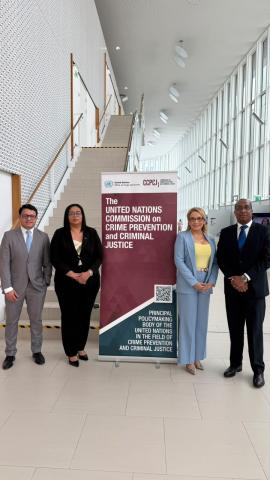

The Superintendency of Banks of Panama (SBP) joined as a panelist in the side event “Disrupting the Economies of Human Trafficking: Asset-Based Approaches and International Cooperation from Latin America,” held as part of the 35th session of the United Nations Commission on Crime Prevention and Criminal Justice.
The event brought together representatives from Peru, Colombia, and Panama to exchange experiences, best practices, and strategies aimed at strengthening institutional capacities in combating human trafficking and preventing money laundering, while promoting regional and international cooperation to address this crime.
During the discussion, the Panamanian delegation highlighted the country's interinstitutional efforts to strengthen mechanisms for preventing and detecting financial transactions linked to human trafficking and other organized crime-related offenses. In this context, the delegation underscored the role of the banking regulator in developing analytical tools, typologies, and red flag indicators to facilitate the identification of transactions potentially associated with these illicit activities.
These initiatives are designed to strengthen the capabilities of banking institutions through the adoption of typologies and red flag indicators incorporated into regulations issued by the SBP, thereby contributing to the disruption of the financial structures that support organized criminal networks.
The SBP was represented by Ana Raquel Velasco, Director of Regulation, and Yoriel Moreno, Deputy Director of Anti-Money Laundering Prevention, who shared Panama’s experience in financial crime prevention through banking regulation and supervision.
The event took place from June 1 to 5 at the United Nations Headquarters in Vienna, Austria, reinforcing the SBP’s commitment to safeguarding the integrity of the financial system, preventing financial crimes, and promoting international cooperation as a key tool in addressing the threats posed by organized crime.